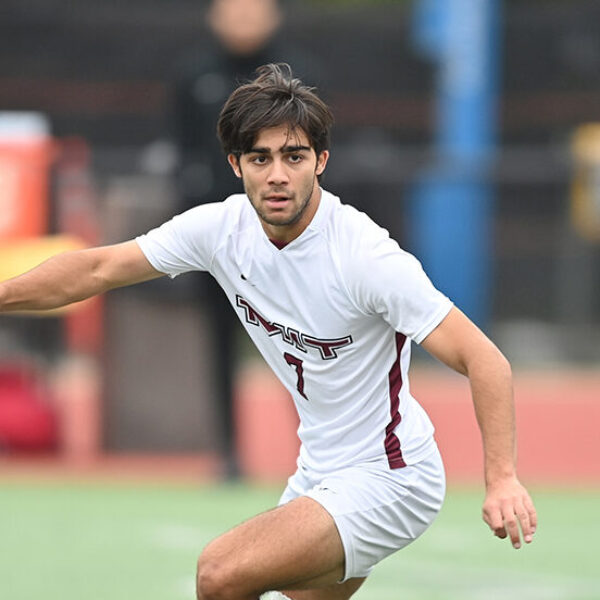


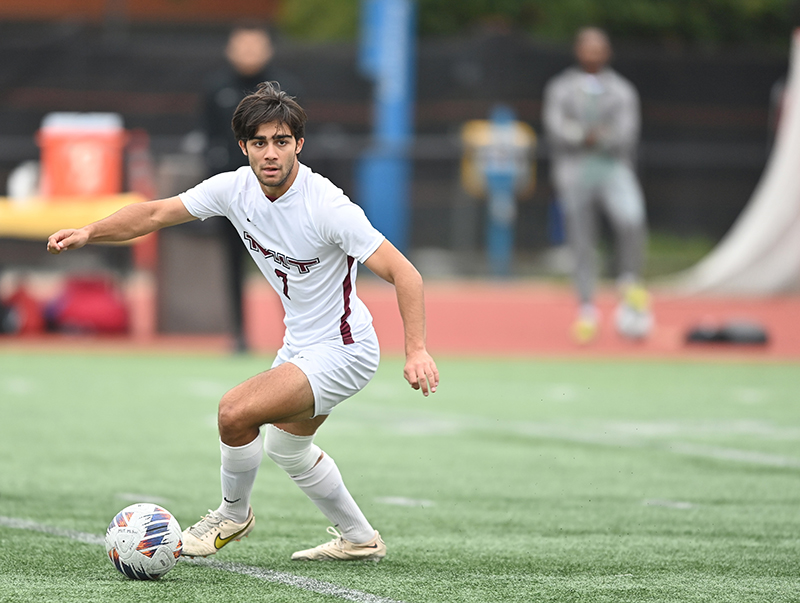
Dilin Meloni is passionate about soccer, nuclear fusion, and advocating on behalf of his fellow student-athletes at MIT.
As a Massachusetts Boys Soccer Player of the Year and an All-American in high school, Meloni had choices when it came to college. He came to MIT because he knew he wanted to be an Engineer (on the field) and an engineer (off) after he read a paper from the Plasma Science and Fusion Center as a junior at Needham High School.
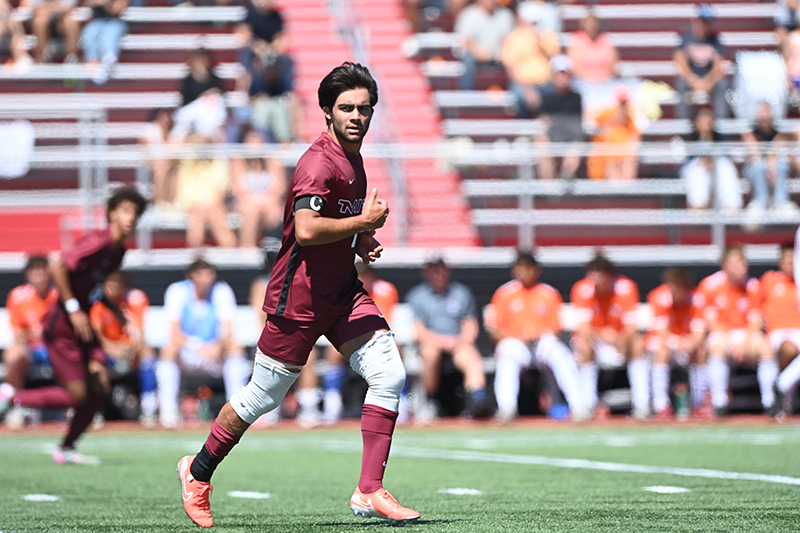
In mid-June, Meloni, a rising senior studying Nuclear Science and Engineering and Physics, took time from his summer internship at Commonwealth Fusion Systems to discuss his role as an attacking midfielder for the Engineers, his work with the Student Athlete Advisory Council, his World Cup predictions, and more.
Q: How does being an athlete affect your experience at MIT?
A: MIT has a huge social experience people don’t really understand from the outside. A lot of it is driven by our athletic communities.
For example, MIT was very open and welcoming when I first got here. Especially for fall athletes; when you get here, it’s all there in the first two weeks. Athletics help you meet students who are very much like yourself: people who come to MIT for academics, but who have also dedicated so much of their lives to a sport that it’s a major part of them. I think this common ground makes it a lot easier to meet people and find connections you might have a harder time finding if you’re not an athlete.
And it still drives how I live. My fraternity is made up of pretty much the entire soccer team now, plus people from the football team, the swimming team, and some track athletes. We have some non-athletes as well.
But the nice part is it doesn’t have to be everything you do—and it never is, because everybody has their academic work.
Q: Are these two parts of your life—atheltic and academic—separate, or integrated?
A: Maybe it’s because of my major and what I’m interested in, but I just don’t find a lot of overlap. I’m a Course 22 and Course 8 double-major, and you don’t find a ton of varsity athletes in nuclear engineering or physics, unfortunately. But I’m trying to change that—the new players coming in, I try to convince them these are good paths to take.
Growing up I spent a lot of time playing club soccer, and my academics were in a much smaller sphere. Here, I get access to every single part of the MIT ecosystem. I’m able to spend time in my lab with people who come from very diverse backgrounds, and they don’t really play sports. Or they don’t anymore.
And at the end of the day, I can go back and hang out with my friends on the team. It’s a privilege to be a part of all these different groups. I’m not just siloed.
Q: Describe the Student Athletics Advisory Committee. How do you represent the needs of all 33 varsity sports?
A: 33 teams is a lot of teams… Last summer we reached out to all the coaches and athletes before the preseason to ask for their ideas. They know where the pain points are, so we encouraged them to think about what changes they wanted. Then the co-president and I met with all of them in smaller groups and came up with a list.
The main idea is that there’s overlap on the issues that pertain to all student-athletes, such as the quality of the food, preseason planning, or the new Sports Performance Facility—every varsity student athlete needs access to that space, so it matters how access and time are allocated.
Or it might be something more specific. There are 7 teams that play on the major turf fields. If you’re a swimmer, you’re probably not going to care much about the soccer fields, but you do share the pool with the water polo team. We also discuss things like NCAA legislation and how the school wants to approach it.
The nice part is, it’s pretty informal. I know a lot of student athletes. If I want to get in touch with someone from the track team, I don’t have to hunt them down. I could probably just find them in class. Or I text my friends and ask, “Hey, how was the food today?”
Q: How did you get involved?
A: I started going my freshman year. My coach suggested that we send some younger players, so I went with the captain at the time.
Student governance has always been important to me. When I was in high school, I was part of my town’s school committee and the larger school committees for Massachusetts. Students have lots of opinions, and there are lots of issues, even at a place like MIT. But if no one takes on the role, nothing’s going to happen. That’s just always how I viewed it—if there’s an area where you can make some change, why not go do it yourself?
Q: What’s the hardest part of the job?
A: The difficult part can be communicating realistic standards between administrators and student athletes, because students are going to ask for more than they’re going to get—which is not necessarily a bad thing. For example, student athletes are aware that we have to share fields. But all these teams always want to be out there. They want to have priority. They want continuous access to facilities so they can train and get better as a team.
In these meetings I’ve come to understand fully that there’s a cost associated with everything, and some things can be difficult, logistically. So finding compromises when it comes to field time, or food, or whatever it may be—I end up explaining a lot. This is how the school works. You can’t just demand everything. We try to meet in the middle as much as possible. Students get it.
But on the flip side, I need to make sure we are voicing student athletes’ needs and ideas for how to improve our experience, because if you’re enjoying your student-athlete experience, you’re going to get more out of the school as well.
Varsity athletes feel sometimes that they are an underrepresented or unloved group. If you’re trying to have a soccer practice and there are people running on the track, or if you kick a ball over the fence and someone steals it, or if you’re trying to book an off-season practice and a student club already booked the field—all these things can be frustrating.
A big part of SAAC is voicing complaints, but also understanding the compromises—and that we can work together to try and find the best middle ground.
Q: Do you think it’s working?
A: Definitely. DAPER and Student Life staff have been willing to talk, and listen, and overhaul how they do things. With such a large portion of the student body being athletes, this is really important to them. They’re now asking me and the co-president for input on other realms of student life, too. I think this year was really a tipping point.
Obviously it’s a privilege to come to this school, but if you’re here you still need to be heard. At the end of the day, people are always going to find things to nitpick. Yes, there are things to improve on; it’s never going to be perfect. But as long as we have this communication channel open, I think we can make small changes that’ll lead to big changes eventually.
Q: Who’s going to win the World Cup?
A: The United States have looked fantastic. I honestly couldn’t believe their first game. And some of the heavy-hitting teams haven’t looked that great to me. Honestly, this could be anybody’s World Cup.
Have a question about this article?
Contact Sarah Foote from the Division of Student Life’s Communications Office at dsl-comm@mit.edu