Persistence, teamwork, and some healthy competition
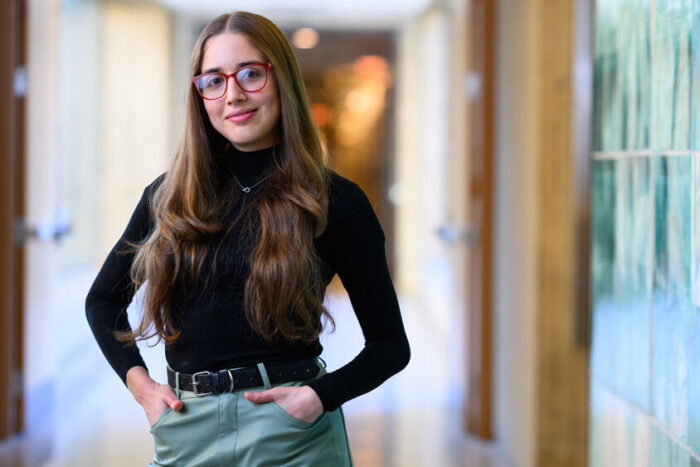


When Veronica Calzadilla Sosa transferred to MIT from Miami Dade College in Florida, she was an incoming second-year student with an interest in chemical engineering. She didn’t know how involved she would soon become as a student leader in the department.
She would also go on to discover her competitive side.
At the encouragement of a friend who was then a team captain, Calzadilla Sosa joined MIT’s chapter of American Institute of Chemical Engineers, and the two worked with the Department of Chemical Engineering to build up the team of students representing MIT in the organization’s lively chemical engineering competitions. As the organization’s competition chair last year and the vice president of external relations this year, she has fallen in love with the club and found joy in bringing students together to work toward a common goal and have fun along the way.
When she first took on the role, MIT was new to the competition, and students were participating in only one of several events. Now, they participate in three categories: ChemE Cube (where teams build a miniature chemical plant that fits inside a 1-cubic-foot cube), ChemE Jeopardy (a “Jeopardy!”-style trivia competition), and ChemE Sports (where teams operate and optimize a virtual chemical plan).
Calzadilla Sosa also captained MIT’s first ChemE Sports team, working alongside two first-year students. At their first competition, their challenge involved optimizing a distillation column, drawing on concepts Calzadilla Sosa was learning in her separation processes class. The team placed second at regionals.
“The competition was challenging, technical, and at times stressful, but also incredibly fun and rewarding,” she said after the event. “Experiences like this remind me how much engineering extends beyond technical knowledge alone.”
For Calzadilla Sosa, the experience was about more than the result. It gave her the chance to take on a leadership role, work through unfamiliar problems with her teammates, and help create an opportunity for students who might not otherwise have participated.
Building community has been particularly important to Calzadilla Sosa, who began her undergraduate education in Cuba before moving to the U.S. When she later transferred to the Institute after earning her associate degree from Miami Dade, where she was part of the Honors College, “I was a sophomore for the third time,” she jokes. At that point, many of her new classmates had already spent a year getting to know one another and finding their footing.
She began to find her place in an unexpected setting: office hours.
During her first chemical engineering class at MIT, Calzadilla Sosa regularly went to office hours for help with difficult problems. She soon noticed that she was not the only one struggling.
“I was there because I was struggling with a problem, but then I would see more people also struggling with the same exact things,” she says. “And that, for some reason, gave me this idea that I wasn’t alone in that sense.”
Those shared struggles became a starting point for conversations, friendships, and a support system. She learned that finding a community did not necessarily mean having everything figured out.
“Sometimes you find your community simply by allowing yourself to struggle alongside other people,” she says.
Throughout her undergraduate experience, Calzadilla Sosa has also explored the many ways chemical engineering can be applied beyond the classroom.
While studying in Miami, she interned with the U.S. Food and Drug Administration, analyzing data on toxic elements in food, and with the engineering consulting firm Jacobs, where she learned about water and wastewater infrastructure projects in the county. As an MIT student, she has been a materials intern at the medical device company Convatec, and a materials chemistry/chemical engineering intern at the startup Folia Materials.
In the process, she has gotten a closer look at different industries and begun to figure out which ones interest her most. At MIT, she has become particularly interested in energy systems and how existing resources and infrastructure can be used more efficiently.
“I think exploring different areas is very valuable,” she says. “I find myself thinking ‘Maybe I could do this or I could do that. Maybe I don’t like this. Maybe I prefer doing another thing.’”
Outside of her studies, Calzadilla Sosa enjoys cooking and baking for family and friends, traveling, and going to concerts and dance performances. She also likes bringing people together, especially when she returns to her first home in Cuba and has the chance to reconnect with loved ones.
As graduation approaches, Calzadilla Sosa is excited to leave student life behind and see where her degree takes her. She has not settled on one career path, but she is comfortable with that uncertainty. After studying at multiple institutions and exploring different corners of chemical engineering, she knows there is still plenty left to discover.
“I spent so many years as an undergrad, so I’m really excited to go to industry and take that next step and see the results of my education,” she says.
Have a question about this article?
Contact Sarah Foote from the Division of Student Life’s Communications Office at dsl-comm@mit.edu