MIT Leaders: Q&A with men’s football co-captain Dominic Hess
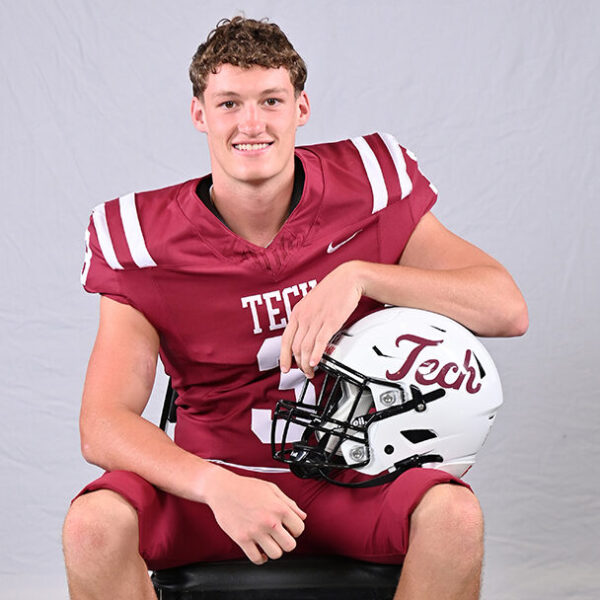


A defensive back and co-captain for the Engineers, Dominic Hess says football keeps him grounded—and inspired.
A senior studying mechanical engineering and finance, Dominic Hess is an Academic All-American with a packed study schedule. But he and his teammates still make room for about 20 hours a week of football during the regular season. (“It’s a little less in the spring,” he notes.) All this time practicing, working out, and playing in games, he says, doesn’t take away from his academic experience at MIT—it amplifies and improves it.
Q: How would you compare your high school football experience to your MIT one?
A: I’m originally from a small town, Damascus, in Maryland. On my way to high school, I would drive past seven farms and a lot of cornfields.
Football was big there, and the town was historically really good; I think we’ve won 12 state championships. I grew up playing several sports and decided to stick with football going into high school. Being in a super-competitive environment was a great experience. In my freshman year, the number-one player in the nation was on my team. And as a five-ten, 135-pound kid playing with a guy who was six-six and 280 pounds, it was crazy—a very high level of football.
I took my academics very seriously and decided I wanted to keep playing in college, but I knew I wasn’t good enough to play at a Division I school. Luckily, I ended up here—and it has been the most impactful four years of my life.
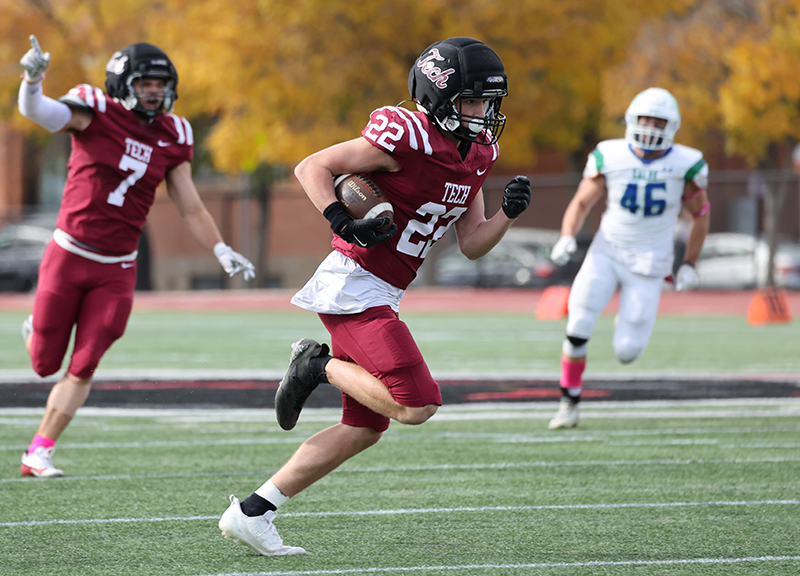
I’ll say, coming to MIT, it was different. I tell people that I play football here, and they’re like—”MIT has a football team?”
CREDIT: Robert Krawitz
Q: How do you strike a balance between academics and football?
A: It definitely took some getting used to, especially during freshman year.
Football actually helped a lot. We come to campus in August, a few weeks before classes start. As a freshman, I had no idea about what classes to take, what the numbers all mean, what the names of things are—all that stuff. But I had all this time where I could talk to my teammates about careers, different majors, and what classes to take. I learned a lot.
Once school starts, you’re taking classes that are harder than anything you’ve ever taken in high school, and the workload is way more than you’ve had before. It’s a huge adjustment, and the balance is not easy—but you get to do it with other people. The community in an athletics team, having built-in friends who can support you, really benefits you on the academic side.
Also, to me, it’s a grounding thing. I have all this other stuff going on—academics, clubs, my fraternity, whatever. When I walk onto the practice field, I say: “I’m just going to focus on football right now.” Those two hours are the one time of my day when I don’t have to worry about anything else. It’s a blessing to be there.
Q: Why did the team make you a captain?
A: I was captain of my high school team, but coming into MIT was a reset. You’re back to being a freshman, back to the bottom of the lineup, just trying to earn your stripes. You need to do the work to become a good player and a good teammate. Over my first three years, I was able to improve a lot. I guess my teammates and my coaches recognized that, and I ended up getting selected.
I think a key thing about being a leader, especially on a sports team, is asking your teammates—what are your goals? And then, just as important, what steps are you going to take to get there? I really want to win a NEWMAC championship, and, obviously, the guys on the team want the same thing. Taking the steps to get there is what’s important. You’re not going to win a championship in a random way in December, but you can do something today and keep stacking it and getting better and better.
Being a captain on the field is a little different. It’s really about keeping players motivated. I’ve been watching this documentary about Nick Saban, the Alabama football coach. He talks about each play being six seconds—and all you have to do is focus on this play and go all out for six seconds.
Q: What motivates you, on and off the field?
A: I’d say, especially at MIT, the community really motivates me. I grew up with three brothers and was very close to my parents. My dad’s in tech consulting and worked at home, so I got to spend a lot of time with him growing up. My mom quit her job to raise us. Four boys is a lot of work. (They’ve made it to every game this season; my mom always jokes how this season will be the end of her “sports-mom” era.)
CREDIT: Gil Talbot/MIT Athletics
And so, coming here, I guess I was looking for a new family—and I was fortunate to find it in football. You hear a lot of things about MIT, like how hard it is and how students can feel alone. It can obviously be hard here, so I wanted to find that community.
I’ve been with the same roommate all four years; we’ve gotten very close. I’m also in a fraternity, DKE [Delta Kappa Epsilon]. Also, being a part of the Catholic community has been really important. It turns out a lot of the guys on the team are also Catholic. I didn’t know I’d find that here.
Q: What’s after MIT for you?
A: I interned in New York City the past three summers and am fortunate to have a job lined up for next year. My two older brothers already live and work there, so I’m planning to move in with them. Both my parents are actually from New York, so unfortunately that means I’m also a Jets fan, and unfortunately, now, I can say it means being a Yankees fan. But the Knicks…
Have a question about this article?
Contact Sarah Foote from the Division of Student Life’s Communications Office at dsl-comm@mit.edu